1) Do not wait; the time will never be ‘just right.’ Start where you stand, and work with whatever tools you may have at your command, and better tools will be found as you go along.
—George Herbert
2) When obstacles arise, you change your direction to reach your goal; you do not change your decision to get there.
—Zig Ziglar
3) Courage is not the absence of fear, but rather the judgment that something else is more important than fear.
—Ambrose Redmoon
4) Hardships often prepare ordinary people for an extraordinary destiny.
—C.S. Lewis
5) Failure will never overtake me if my determination to succeed is strong enough.
—Og Mandino
6) Develop success from failures. Discouragement and failure are two of the surest stepping stones to success.
—Dale Carnegie
7) When something is important enough, you do it even if the odds are not in your favor.
— Elon Musk
8) The man who moves a mountain begins by carrying away small stones.
—Confucius
9) The people who are crazy enough to think they can change the world are the ones who do.
—Rob Siltanen
10) Imagine your life is perfect in every respect; What would it look like?
—Brian Tracy
11) Your time is limited, so don’t waste it living someone else’s life. Don’t be trapped by dogma – which is living with the results of other people’s thinking. Don’t let the noise of others’ opinions drown out your own inner voice. And most important, have the courage to follow your heart and intuition.
—Steve Jobs
12) We generate fears while we sit. We overcome them by action.
— Henry Link
13) Energy and persistence conquer all things.
—Benjamin Franklin
14) For every reason it’s not possible, there are hundreds of people who have faced the same circumstances and succeeded.
—Jack Canfield
15) Infuse your life with action. Don’t wait for it to happen. Make it happen. Make your own future. Make your own hope. Make your own love. And whatever your beliefs, honor your creator, not by passively waiting for grace to come down from upon high, but by doing what you can to make grace happen… yourself, right now, right down here on Earth.
—Bradley Whitford
16) Don’t judge each day by the harvest you reap but by the seeds that you plant.
— Robert Louis Stevenson
17) A winner is a dreamer who never gives up.
—Nelson Mandela
Author: Ken Thompson
17 Quotes That Will Inspire You to Live Your Dream
1) If you can’t figure out your purpose, figure out your passion. For your passion will lead you right into your purpose.
—Bishop T.D. Jakes2) Almost everything–all external expectations, all pride, all fear of embarrassment or failure–these things just fall away in the face of death, leaving only what is truly important. Remembering that you are going to die is the best way I know to avoid the trap of thinking you have something to lose. You are already naked. There is no reason not to follow your heart.
— Steve Jobs3) I’ve been absolutely terrified every moment of my life and I’ve never let it keep me from doing a single thing that I wanted to do.
— Georgia O’Keefe4) If you don’t go after what you want, you’ll never have it. If you don’t ask, the answer is always no. If you don’t step forward, you’re always in the same place.
— Nora Roberts5) A year from now you may wish you had started today.
—Karen Lamb6) How wonderful it is that nobody need wait a single moment before starting to improve the world.
— Anne Frank7) Twenty years from now you will be more disappointed by the things that you didn’t do than by the ones you did do. So throw off the bowlines. Sail away from the safe harbor. Catch the trade winds in your sails. Explore. Dream. Discover.
— Mark Twain8) You are never too old to set another goal or to dream a new dream.
— C.S. Lewis9) Follow your bliss and the universe will open doors where there were only walls.
— Joseph Campbell10) When one door of happiness closes, another opens, but often we look so long at the closed door that we do not see the one that has been opened for us.
— Helen Keller11) Start where you are. Use what you have. Do what you can.
—Arthur Ashe12) There are those who work all day. Those who dream all day. And those who spend an hour dreaming before setting to work to fulfill those dreams. Go into the third category because there’s virtually no competition.
— Steven J. Ross13) The Man Who Has Confidence In Himself Gains The Confidence Of Others.
— Hasidic Proverb14) The most difficult thing is the decision to act, the rest is merely tenacity.
— Amelia Earhart15) Follow your own passion—not your parents’, not your teachers’—yours.
—Robert Ballard16) All progress takes place outside of your comfort zone.
— Michael Bobak17) The journey of a thousand miles begins with one step.
—Lao Tzu
What’s Normal for the Spider is Chaos for the Fly
Nothing and no one is “normal”.
There are solely commonalities labeled as normal, and rarities labeled as abnormal, in relation to YOUR experiences...
Spiders build webs to catch flies and other bugs. Flies eat poop, fly around, and many get caught in spiders’ webs, which results in the fly’s death and a spider’s meal. It’s chaos for the fly, but extremely common for the spider.
The same notion can relate to humans – what’s normal for one human would be chaos for another.
For example, say JonJo grows up in a loving household where arguments almost never happen. JonJo goes over to his friend Willis’s house where Willis’s parents argue on the daily — this causes JonJo discomfort because it’s not what he is used to; this is chaos for JonJo, but it’s predictable for Willis.
Another example is in regards to the food we eat. Let’s say JonJo grew up in a household that eats a variety of foods, including all sorts of meats. Willis, on the other hand, grew up in a house that doesn’t eat meat, except for dog on occasion, as dog is a popular food in some countries. JonJo may see eating dog as chaos where Willis doesn’t, and I’m sure the dog sees it as chaos.
The main takeaway from this idea is that every“one” and every“thing” is trying to do things that are normal to them. “Normal” is a predisposition – it’s a concept that has been uniquely formed in each person as a result of the environment they grew up in and the experiences they have had.
This also relates to societal standards throughout time. What was once accepted as normal is now considered chaos, and some things that were considered chaos are now seen as normal. It usually depends on who is judging the experience, but there is an elusive objective perspective.
There is no such thing as “normal”.
There’s solely what is normal for you.
You are the spider AND the fly…
It just depends on who is doing the interpreting.
Perfection IS the Goal. Progress is what we get.
A lot of people say “don’t try to be perfect” but I disagree.
DO try to be perfect but FIRST DEFINE what perfect is for you!
Perfect is an ideal but it IS something to aim for.
If you don’t aim for the bullseye you’ll never hit it.
If you’re a pitcher in baseball you usually aim for the strike zone.
Pitchers aim for perfection.
Aim for progress and you’ll get less than that.
Aim for perfection and you’ll get progress.
Think about areas in your life that you would like to improve and then aim for the best possible outcome.
The more you aim for what you want, the more you’ll get it. Again, a dart thrower wanting to hit bullseye but never aiming for bullseye will most likely never hit it.
Of course not everything will go perfect, but if you never aim for it you’ll never come close.
Set your aim to the best possible outcome, take action, repeat.
Perfection is the aim. Progress is what you get.
A John Lennon Song for Dreamers & Doers
“Watching The Wheels” by John Lennon
Lyrics beneath the video! Enjoy!! :))
Full Lyrics:
People say I’m crazy
Doing what I’m doing
Well, they give me all kinds of warnings
To save me from ruin
When I say that I’m okay, well they look at me kinda strange
“Surely, you’re not happy now, you no longer play the gaaaammeeeeeeee”
People say I’m lazy
Dreaming my life away
Well they give me all kinds of advice
Designed to enlighten me
When I tell them that I’m doing fine watching shadows on the wall
“Don’t you miss the big time boy, you’re no longer on the ballllllllll?”
I’m just sitting here watching the wheels go round and round
I really love to watch them roll
No longer riding on the merry-go-round
I just had to let it go
Ah, people askin questions
Lost in confusion
Well I tell them there’s no problem
Only solutions
Well they shake their heads and they look at me as if I’ve lost my mind
I tell them there’s no hurry, I’m just sitting here doing timeeeeeeeeee
Lost in confusion
Well I tell them there’s no problem
Only solutions
Well they shake their heads and they look at me as if I’ve lost my mind
I tell them there’s no hurry, I’m just sitting here doing timeeeeeeeeee
I’m just sitting here watching the wheels go round and round
I really love to watch them roll
No longer riding on the merry-go-round
I just had to let it go
No longer riding on the merry-go-round
I just had to let it go
I just had tooo let it go
I just had toooooooo let it gooooooo
Well, there it is. Love this song. What’s your favorite part of this song?
Why It’s ESSENTIAL for you to Define Success
Why is it important for you to define success?
- It will determine everything you do
- Everything you do determines the quality of your future
- Your future always comes in the form of ‘today’
Defining success gives you an anchor to what is true to you. It helps you stay focused and puts you on a path toward your success.
“Where focus goes, energy flows.”
Tony Robbins
The term “success” has often been related to having a lot of money, but a more accurate definition of success comes from Oxford Dictionary: “the accomplishment of an aim or purpose.”
If success is the accomplishment of an aim or purpose then success must mean something different to each person.
Maybe success to one person is taking care of their needs while success to someone else is earning $1,000,000 dollars.
The person who defines success as taking care of their needs prioritizes that first in their life, whereas the person who wants to make $1,000,000 dollars may prioritize making money first. Someone who sees success as balancing work with passion will prioritize work with their passion, but in all scenarios each person is guided by what success means to them.
So instead of debating the question “what is real success?” Ask yourself “what does success mean to me?”
When you know what success is for you you automatically put yourself on a path toward that success, but there are distractions all around us. If you don’t have an anchor of what success means to you, to focus on, you’ll get pushed and pulled and never achieve success. Some people spend their entire lives wandering around this Earth questioning why they were never able to achieve success.
Don’t let that be you.
Write down what success means to you on a notecard.
Put it somewhere that you’ll be able to see it everyday.
Let your definition of success guide you to it.
2 Acting Strategies to Improve Work & Life
Acting strategies can be used as tools to improve your work environment as well as your life.
If these strategies have enlightened Jim Carrey, in which you can read about below, they might be able to do the same for you. Give them a try and use what works for you!
Acting Strategies To Try At Work
1) Act “As If”
The HuffPost has a good article on Acting “As If”. Click here to read it. The article looks at both sides of this exercise and discusses its benefits. Here is an encapsulating quote from the article:
“When we choose to live with a strong faith in things not seen, not proven, and not guaranteed – we tap into the power of the possible and we supersede the literal and predicable.”
Another good quote from article:
“The question for us to ask ourselves is, ‘What am I acting as if will happen in the most important areas of my life right now?’”
So what do you want to act “as if”?
Think about specific qualities you admire and/or think about one of your role models or a leader in your industry. What would they do in this situation?
Then try it out! Don’t give up after 3 minutes, take time to really dwell in an “as if” situation.
This leads to something similar…
2) Create, then don’t leave your “Stage”
This is another type of method acting.
“All the world’s a stage, and all the men and women merely players: they have their exits and their entrances; and one man in his time plays many parts, his acts being seven ages.”
Shakespeare
Every day people are waking up and playing a role; some do it intentionally and some don’t.
The following strategy can be used in any occupation:
Let’s say that you are a pharmacist. In this exercise this is also your “acting role”. Try going into your job pretending that you are an actor, acting as a pharmacist. View everyone you see as fellow actors, acting out their roles!
^This idea can be a trip but I love it.
Related to this strategy is the article about Jim Carrey when he used Method Acting in portraying Andy Kaufman. Check it out here.
Seeing others as fellow actors can help you understand that each “actor” has a role, they have tasks, they are focused on an end goal. This can help you understand peoples’ wants:
“One of the most important keys to acting is that every single person at every single moment of their life has an objective (a want) as well as an action to get what they want. In acting, if you can identify what your character wants at any given time, then you will add a vital element of truth and direction in your work. The same applies to life.”
Dominic Zhai
Knowing that each “actor” has an objective can help you react less and respond more. Reactions are quick and usually without thought whereas Responses are calm and calculated. Reactions are emotional and typically ego-based. Responses are reasonable.
“When egos act defensively (e.g. when we insist that the other person is “wrong”), our judgement becomes clouded. When we focus too much on defending ourselves, we become blocked in our own self-development.”
Dominic Zhai
One of the best qualities an actor can have is active listening. Active listening lets go of the ego to completely engage and focus on the present moment, open to all possibilities(trusting improv), which is where real Joy is experienced, and isn’t that what it’s about?
Joy is contagious. Try the first method to Act “As If” joyful wherever you are and observe the people in your surroundings become more joyful too!
“If you carry joy in your heart, you can heal any moment.”
Carlos Santana
Actions become habits if repeated long enough, but remember that progress is the goal, not perfection. Every day won’t shine as you’d like but you can work on shining every day.
“Joy is increased by spreading it to others.”
Robert Murray McCheyne
“Let your joy be in your journey—not in some distant goal.”
Tim Cook
“There are those who give with joy, and that joy is their reward.”
Kahlil Gibran
It’s okay to fail
Failure…
It can be defined in a number of different ways.
The first definition of failure in the dictionary is “lack of success.”
The second definition of failure in the dictionary is “the omission of expected or required action.”
There are more definitions of failure in the dictionary and although they have close meanings, just a few different words can change the meaning of a word completely.
Looking at the first two definitions of failure it seems to me that those two definitions are quite different.
Personally I don’t believe “lack of success” is an accurate definition of failure because success can also be defined in countless ways. A lot of people consider having lots of money equals success but many people are born into wealth…Are they successful?
For me, the second definition of failure seems more accurate: “The omission of expected or required action.” This definition is more accurate because it tells me that failure is not doing what one knows they should do in order to achieve something. This definition is accurate to me even though successful people fail from time to time. The one thing they don’t do is fail for good. They persist through failure. They see failure as a lesson to learn from instead of a barrier.
It really is okay to fail. And it’s okay to give up too. It’s all okay. But can you accept giving up in pursuit of something you haven’t achieved yet?
Pursuing a dream will involve failures. You choose if they are temporary or fatal failures. Your real choices show up in your actions.
It truly is okay either way. The world will go on with or without us. The real question is, will you go on with or without your dream?
4 Encapsulating Messages from the Book “The Alchemist”
“…That’s what alchemists do. They show that, when we strive to become better than we are, everything around us becomes better, too.”
“What is an alchemist?”
“It’s a man who understands nature and the world.”
…

The book The Alchemist follows the story of a boy, Santiago, who becomes a shepherd to pursue his dream of traveling to “know the world,” he says.
Santiago’s parents wanted him to become a priest but he insisted on following his passion of traveling. When he told his parents he wanted to travel and not be a priest his father was against the idea at first but ended up supporting his son with 3 gold coins.
“If someone isn’t what others want them to be, the others become angry. Everyone seems to have a clear idea of how other people should lead their lives, but none about his or her own.”
During Santiago’s travels as a shepherd he encounters a woman who interprets dreams. He has been having a reoccurring dream so he decides to have her interpret it, although he is hesitant in trusting her.
She tells him “dreams are the language of God” and after hearing his dream she tells him he must go to the pyramids in Egypt where there is a treasure for him. Santiago was disappointed in her interpretation so he left but his journey continued…
The next person Santiago encounters is a king:
Santiago: “Why would a king be talking to a shepherd?”
King: “For several reasons. But let’s say that the most important is that you have succeeded in discovering your destiny…”
“The boy didn’t know what a person’s ‘destiny’ was.”
King: “It’s what you have always wanted to accomplish. Everyone, when they are young, knows what their destiny is…
…At that point in their lives, everything is clear and everything is possible. They are not afraid to dream, and to yearn for everything they would like to see happen to them in their lives. But, as time passes, a mysterious force begins to convince them that it will be impossible for them to realize their destiny.”
“The old man(king) pointed to a baker standing in his shop window at one corner of the plaza. ‘When he was a child, that man wanted to travel too. But he decided first to buy his bakery and put some money aside. When he’s an old man, he’s going to spend a month in Africa. He never realized that people are capable, at any time in their lives, of doing what they dream of.’”
…
“’What’s the world’s greatest lie?’ The boy asked…
‘It’s this: that at a certain point in our lives, we lose control of what’s happening to us, and our lives become controlled by fate. That’s the world’s greatest lie.’”
Santiago’s decision to live a life that he wanted rather than what his parents wanted for him sent him in the direction of living his dreams. He followed his intuitive voice within and that made all the difference.
“He still had some doubts about the decision he had made. But he was able to understand one thing: making a decision was only the beginning of things. When someone makes a decision, he is really diving into a strong current that will carry him to places he had never dreamed of when he first made the decision.”
…
Over the course of the book Santiago meets a number of other people who all seem to be in his life for a reason beyond his momentary understanding. He learns lessons as he faces obstacles and setbacks which come when any person chooses to pursue their dreams.
“He read the lives of the various people who have succeeded in doing so…They were fascinating stories: each of them lived out his destiny to the end. They traveled, spoke with wise men, performed miracles for the incredulous, and owned the Philosopher’s Stone and the Elixir of Life.”
 …
…
Santiago learns many things throughout his journey like to persist in following his dreams although he is continually tested, to trust life and the process, and that the “soul of the world” is a world beyond words.
“‘That’s the principle that governs all things,’ he said. ‘In alchemy, it’s called the Soul of the World. When you want something with all your heart, that’s when you are closest to the Soul of the World. It’s a positive force.’”
…
Learn more about The Alchemist in the following 4 sections of encapsulating messages:
1) Follow your Dreams
2) You will be Tested
3) Trust Life and the Process
4) The Soul of the World
5) Favorite 23 Quotes from The Alchemist
 1) Follow your Dreams
“But what if I can’t?”
“Then you’ll die in the midst of trying to realize your destiny. That’s a lot better than dying like millions of other people, who never even knew what their destinies were.”
“He still had some doubts about the decision he had made. But he was able to understand one thing: making a decision was only the beginning of things. When someone makes a decision, he is really diving into a strong current that will carry him to places he had never dreamed of when he first made the decision.”
“Why don’t people’s hearts tell them to continue to follow their dreams?”
“Because that’s what makes a heart suffer most, and hearts don’t like to suffer.”
“If a person is living out his destiny, he knows everything he needs to know. There is only one thing that makes a dream impossible to achieve: the fear of failure.”
“And what went wrong when other alchemists tried to make gold and were unable to do so?”
“They were looking only for gold. They were seeking the treasure of their destiny, without wanting actually to live out the destiny.”
“People are afraid to pursue their most important dreams, because they feel that they don’t deserve them, or that they’ll be unable to achieve them.”
“My heart is afraid that it will have to suffer.”
“Tell your heart that the fear of suffering is worse than the suffering it self. And that no heart has ever suffered when it goes in search of its dreams, because every second of the search is a second’s encounter with God and with eternity.”
“Don’t give in to your fears. If you do, you won’t be able to talk to your heart.”
“…When I have been truly searching for my treasure, Ive discovered things along the way that I never would have seen had I not had the courage to try things that seemed impossible for a shepherd to achieve.”
“It’s true; life really is generous to those who pursue their destiny.”
“To do that successfully, I must have no fear of failure. It was my fear of failure that first kept me from attempting the Master Work. Now, I’m beginning what I could have started ten years ago. But I’m happy at least that I didn’t wait twenty years.”
“Everyone on earth has a treasure that awaits him,’ his heart said. ‘We, people’s hearts, seldom say much about those treasures, because people no longer want to go in search of them. We speak of them only to children. Later, we simply let life proceed, in its own direction, toward its own fate. But, unfortunately, very few follow the path laid out for them—the path to their destinies, and to happiness. Most people see the world as a threatening place, and, because they do, the world turns out, indeed, to be a threatening place.”
“And anyone who interferes with the destiny of another thing never will discover his own.”
“The boy told himself that, on the way toward realizing his own destiny, he had learned all he needed to know, and had experienced everything he might have dreamed of.”

2) You will be Tested
“The closer he got to the realization of his dream, the more difficult things became…In his pursuit of the dream, he was being constantly subjected to tests of his persistence and courage. So he could not be hasty, not impatient. If he pushed forward impulsively, he would fail to see the signs and omens left by God along his path.”
“He realized that he had to choose between thinking of himself as the poor victim of a thief and as an adventurer in quest of his treasure.”
“‘I had to test your courage,’ the stranger said. Courage is the quality most essential to understanding the Language of the World.”
“…You must not let up, even after having come so far. You must love the desert, but never trust it completely. Because the desert tests all men: it challenges every step, and kills those who become distracted.”
“‘Once you get into the desert, there’s no going back,’ said the camel driver. ‘And, when you can’t go back, you have to worry only about the best way of moving forward.’”
“It’s only those who are persistent, and willing to study things deeply, who achieve the Master Work.”
“What you still need to know is this: before a dream is realized, the Soul of the World tests everything that was learned along the way. It does this not because it is evil, but so that we can, in addition to realizing our dreams, master the lessons we’ve learned as we’ve moved toward that dream. That’s the point at which most people give up. It’s the point at which, as we say in the language of the desert, one ‘dies of thirst just when the palm trees have appeared on the horizon.’”
“…Every search begins with beginner’s luck. And every search ends with the victor’s being severely tested.”
“To show you one of life’s simple lessons. When you possess great treasures within you, and try to tell others of them, seldom are you believed.”
“When someone sees the same people every day, as had happened with him at the seminary, they wind up becoming a part of that person’s life. And then they want the person to change. If someone isn’t what others want them to be, the others become angry. Everyone seems to have a clear idea of how other people should lead their lives, but none about his or her own.”
“One is loved because one is loved. No reason is needed for loving.”
“In his heart, he felt a strange sense of joy: he was about to die in pursuit of his destiny.”
 3) Trust Life and the Process
“Well, maybe I just want to know the future so I can prepare myself for what’s coming.”
“If good things are coming, they will be a pleasant surprise. If bad things are, and you know in advance, you will suffer greatly before they even occur.”
“We are afraid of losing what we have, whether it’s our life or our possessions and property. But this fear evaporates when we understand that our life stories and the history of the world were written by the same hand.”
“When you want something, all the universe conspires to help you achieve it. But the old king hadn’t said anything about being robbed, or about endless deserts, or about people who know what their dreams are but don’t want to realize them.”
“In order to find the treasure, you will have to follow the omens. God has prepared a path for everyone to follow. You just have to read the omens that he left for you.”
“There’s no such thing as coincidence…”
“The boy knew what he was about to describe though: the mysterious chain that links one thing to another, the same chain that had caused him to become a shepherd, that had caused his recurring dream, that had brought him to a city near Africa, to find a king, and to be robbed in order to meet a crystal merchant, and…”
“He had not a cent in his pocket, but he had faith.”
“The camel driver, though, seemed not to be very concerned with the threat of war. ‘I’m alive,’ he said to the boy. ‘When I’m eating, that’s all I think about. If I’m on the march, I just concentrate on marching. If I have to fight, it will be just as good a day to die as any other. Because I don’t live in either my past or my future. I’m interested only in the present. If you can concentrate always on the present, you’ll be a happy man.”
“When you are in love, things make even more sense.”
“Don’t forget that everything you deal with is only one thing and nothing else. And don’t forget the language of omens. And, above all, don’t forget to follow your destiny through to its conclusion.”
“Don’t think about what you’ve left behind…Everything is written in the Soul of the World, and there it will stay forever…If what one finds is made of pure matter, it will never spoil. And one can always come back. If what you had found was only a moment of light, like the explosion of a star, you would find nothing on your return.”
4) Soul of the World
“He learned the most important part of the language that all the world spoke—the language that everyone on earth was capable of understanding in their heart. It was love.”
“It was the pure Language of the World. It required no explanation, just as the universe needs none as it travels through endless time.”
“I learned that the world has a soul, and that whoever understands that soul can also understand the language of things.”
“You already know about alchemy. It is about penetrating to the Soul of the World, and discovering the treasure that has been reserved for you.”
“…And then there were the others, who were interested only in gold. They never found the secret.”
“What you still need to know is this: before a dream is realized, the Soul of the World tests everything that was learned along the way. It does this not because it is evil, but so that we can, in addition to realizing our dreams, master the lessons we’ve learned as we’ve moved toward that dream. That’s the point at which most people give up. It’s the point at which, as we say in the language of the desert, one ‘dies of thirst just when the palm trees have appeared on the horizon.’”
“At that moment, it seemed to him that time stood still, and the Soul of the World surged within him.”
“He realized: If I can learn to understand this language without words, I can learn to understand the world.”
“This Soul of the World allowed them to understand anything on the face of the earth, because it was the language with which all things communicated.”
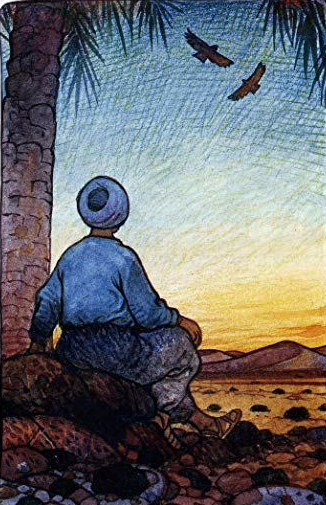
“No. It’s like the flight of those two hawks; it cannot be understood by reason alone. The Emerald Tablet is a direct passage to the Soul of the World…”
“Love is the force that transform and improves the Soul of the World.”
“The boy reached through to the Soul of the World, and saw that it was a part of the Soul of God. And he saw that the Soul of God was his own soul. And that he, a boy, could perform miracles.”
“‘Everything in life is an omen’, said the Englishman… ‘There is a universal language, understood by everybody, but already forgotten. I am in search of that universal language, among other things. That’s why I’m here. I have to find a man who knows that universal language. An alchemist.’”
“All his life and all his studies were aimed at finding the one true language of the universe.”
“How do I immerse myself in the desert?”
“Listen to your heart. It knows all things, because it came from the Soul of the World, and it will one day return there.”
“‘The desert takes our men from us, and they don’t always return,’ she said. ‘We know that, and we are used to it. Those who don’t return become a part of the clouds, a part of the animals that hide in the ravines and of the water that comes from the earth. They become a part of everything…they become the Soul of the World.”
“In the silence, the boy understood that the desert, the wind, and the sun were also trying to understand the signs written by the hand, and were seeking to follow their paths, and to understand what had been written on a single emerald. He saw that omens were scattered throughout the earth and in space, and that there was no reason or significance attached to their appearance; he could see that not the deserts, nor the winds, nor the sun, not people knew why they had been created. But that the hand had a reason for all of this, and that only the hand could perform miracles, or transform the sea into a desert…or a man into the wind.”
“He had only one explanation for this fact: things have to be transmitted this way because they were made up from the pure life, and this kind of life cannot be captured in pictures or words. Because people become fascinated with pictures and words, and wind up forgetting the Language of the World.”

5) My Favorite 23 Quotes from The Alchemist
1) “One is loved because one is loved. No reason is needed for loving.”
2) “…That’s what alchemists do. They show that, when we strive to become better than we are, everything around us becomes better, too.”
3) “The old man pointed to a baker standing in his shop window at one corner of the plaza. ‘When he was a child, that man wanted to travel too. But he decided first to buy his bakery and put some money aside. When he’s an old man, he’s going to spend a month in Africa. He never realized that people are capable, at any time in their lives, of doing what they dream of.’”
4) “But what if I can’t?”
“Then you’ll die in the midst of trying to realize your destiny. That’s a lot better than dying like millions of other people, who never even knew what their destinies were.”
5) ) “If someone isn’t what others want them to be, the others become angry. Everyone seems to have a clear idea of how other people should lead their lives, but none about his or her own.”
6) “He still had some doubts about the decision he had made. But he was able to understand one thing: making a decision was only the beginning of things. When someone makes a decision, he is really diving into a strong current that will carry him to places he had never dreamed of when he first made the decision.”
7) “My heart is afraid that it will have to suffer.”
“Tell your heart that the fear of suffering is worse than the suffering it self. And that no heart has ever suffered when it goes in search of its dreams, because every second of the search is a second’s encounter with God and with eternity.”
8) “And what went wrong when other alchemists tried to make gold and were unable to do so?”
“They were looking only for gold. They were seeking the treasure of their destiny, without wanting actually to live out the destiny.”
9) “He learned the most important part of the language that all the world spoke—the language that everyone on earth was capable of understanding in their heart. It was love.”
10) “To show you one of life’s simple lessons. When you possess great treasures within you, and try to tell others of them, seldom are you believed.”
11) “It’s only those who are persistent, and willing to study things deeply, who achieve the Master Work.”
12) “In his heart, he felt a strange sense of joy: he was about to die in pursuit of his destiny.”
13) “‘I had to test your courage,’ the stranger said. ‘Courage is the quality most essential to understanding the Language of the World.”
14) “What you still need to know is this: before a dream is realized, the Soul of the World tests everything that was learned along the way. It does this not because it is evil, but so that we can, in addition to realizing our dreams, master the lessons we’ve learned as we’ve moved toward that dream. That’s the point at which most people give up. It’s the point at which, as we say in the language of the desert, one ‘dies of thirst just when the palm trees have appeared on the horizon.’”
15) “Well, maybe I just want to know the future so I can prepare myself for what’s coming.”
“If good things are coming, they will be a pleasant surprise. If bad things are, and you know in advance, you will suffer greatly before they even occur.”
16) “There’s no such thing as coincidence…”
“The boy knew what he was about to describe though: the mysterious chain that links one thing to another, the same chain that had caused him to become a shepherd, that had caused his recurring dream, that had brought him to a city near Africa, to find a king, and to be robbed in order to meet a crystal merchant, and…”
17) “‘Everything in life is an omen’, said the Englishman… ‘There is a universal language, understood by everybody, but already forgotten. I am in search of that universal language, among other things.'”
18) “It was the pure Language of the World. It required no explanation, just as the universe needs none as it travels through endless time.”
19) “When you are in love, things make even more sense.”
20) “How do I immerse myself in the desert?”
“Listen to your heart. It knows all things, because it came from the Soul of the World, and it will one day return there.”
21) “Don’t think about what you’ve left behind…Everything is written in the Soul of the World, and there it will stay forever…If what one finds is made of pure matter, it will never spoil. And one can always come back. If what you had found was only a moment of light, like the explosion of a star, you would find nothing on your return.”
22) “He had only one explanation for this fact: things have to be transmitted this way because they were made up from the pure life, and this kind of life cannot be captured in pictures or words. Because people become fascinated with pictures and words, and wind up forgetting the Language of the World.”
23) “The camel driver, though, seemed not to be very concerned with the threat of war. ‘I’m alive,’ he said to the boy. ‘When I’m eating, that’s all I think about. If I’m on the march, I just concentrate on marching. If I have to fight, it will be just as good a day to die as any other. Because I don’t live in either my past or my future. I’m interested only in the present. If you can concentrate always on the present, you’ll be a happy man.”
…
I hope you enjoyed these messages from The Alchemist!
Receive related quotes and ideas once a week, subscribe to my weekly newsletter here!
Stop Waiting. Start Doing.
Dr. Seuss’s poem on “The Waiting Place” accurately describes the mentality of many people, including myself as I often live with anticipation, ‘waiting’ for something…
“You can get so confused
that you’ll start in to race
down long wiggled roads at a break-necking pace
and grind on for miles across weirdish wild space,
headed, I fear, toward a most useless place.
The Waiting Place…
…for people just waiting.
Waiting for a train to go
or a bus to come, or a plane to go
or the mail to come, or the rain to go
or the phone to ring, or the snow to snow
or waiting around for a Yes or a No
or waiting for their hair to grow.
Everyone is just waiting.
Waiting for the fish to bite
or waiting for wind to fly a kite
or waiting around for Friday night
or waiting, perhaps, for their Uncle Jake
or a pot to boil, or a Better Break
or a sting of pearls, or a pair of pants
or a wig with curls, or Another Chance.
Everyone is just waiting.
NO!
That’s not for you!
Somehow you’ll escape
all that waiting and staying.
You’ll find the bright places
where Boom Bands are playing…”
Can you relate to the poem?
How often do you find yourself waiting?
You CAN find bright places by shifting your focus, but it’s easier said than done.
ASKING QUESTIONS is a way of shifting your mentality and can be helpful in getting out of “The Waiting Place.”
“Problems that remain persistently insoluble should always be suspected as questions asked in the wrong way.”
Alan Watts
One of the most practical series of questions, with an example, you can ask yourself to wait less, be more productive, and enjoy life more is:
1) “What am I waiting for?”
Example – “Retirement so that I can enjoy life.”
Then Ask:
2) “What can I do instead of waiting?”
“Instead of waiting for retirement to begin enjoying life I can pursue interests and hobbies in my free time and who knows, maybe I’ll get paid to do something I love.”
Or Ask:
3) “What can I do while I wait?”
“While I wait for retirement I can begin thinking and planning things I want to do when I retire. Maybe I can even add some of these activities throughout the work week now.”
This series of questions can be used to relieve your waiting in any situation.
Asking yourself the right questions helps shift your perspective.
When you ask yourself negative questions you get negative answers, like “Why do bad things keep happening to me?” Even if you involuntarily ask that question your brain will subconsciously look for answers.
When you ask yourself questions that focus more on solving problems you have you will solve your problems and/or at least cultivate a forward-thinking perspective.
Read more on the power of questions here.
“…With banner flip-flapping,
once more you’ll ride high!
Ready for anything under the sky.
Ready because you’re that kind of a guy! (or girl)
Oh, the places you’ll go! There is fun to be done!
There are points to be scored. There are games to be won.
And the magical things you can do with that ball
will make you the winning-best winner of all.”
Dr. Suess
(Continued from “The Waiting Place” poem above.)
So are you ready to live a life with less waiting?
More joy, and more action, more love, and less hating?
^I was feeling inspired by Dr. Suess.
I hope you have an awesome day and continue to ask yourself innovative, problem-solving questions!
 With Ken Thompson